
Source:Industry News Release time:2022-03-07 Clicks:0 Popular:Reduction motor manufacturer
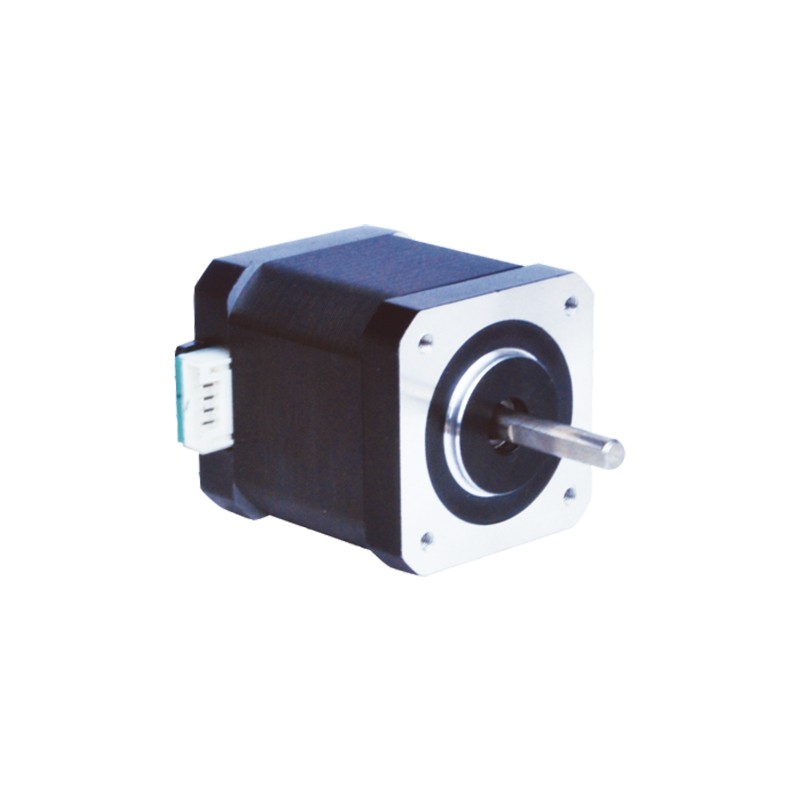
Stepper motors are specialized motors designed to precisely control position and speed. Its working principle is to use electronic circuits to convert direct current into time-sharing power, multi-phase sequential control current, and use this current as a stepper motor power supply. The stepper motor can work normally, and the driver is a time-sharing power supply and a multi-phase sequence controller for the stepper motor. Let me introduce to you the differences between 42, 57 and 86 stepper motors.
42 stepper motor refers to a stepper motor with a mounting base size of 42mm, and its maximum output torque is 0.5NM;
57 stepper motor refers to a stepper motor with a mounting base size of 57mm and a maximum output torque of 3.0NM;
86 stepper motor refers to a stepper motor with a mounting base size of 86mm, which is a high-precision motor.
42 series two-phase stepper motor parameters:
Step accuracy 5%
Temperature 80℃ Max
Ambient temperature -20℃—50℃
Insulation resistance 100M Ω Min 500VDC
Withstand voltage 500V AC 1 minute
Maximum radial runout 0.02mm (450g load)
Maximum axial runout 0.08mm (450g load)
57 series two-phase stepper motor parameters:
Insulation resistance 100M Ω Min 500VDC
Withstand voltage 500V AC 1 minute
Maximum radial runout 0.02mm (450g load)
Maximum axial runout 0.08mm (450g load)
86 series two-phase stepper motor parameters:
Step accuracy 5%
Temperature 80℃ Max
Ambient temperature -20℃—50℃
Insulation resistance 100M Ω Min 500VDC
Withstand voltage 500V AC 1 minute
Maximum radial runout 0.02mm (450g load)
Maximum axial runout 0.08mm (450g load)
The above content is an introduction to the differences between 42, 57 and 86 stepper motors. The biggest feature of the stepper motor is its "digitization". For each pulse signal sent by the controller, the stepper motor is driven by its driver. If a series of pulses are received, the stepper motor will continuously run the corresponding distance. At the same time, the motor speed can be directly controlled by controlling the frequency. Because the working principle of stepper motors is easy to learn and use, has low cost (compared to servo), and the motor and driver are not easily damaged, it is very suitable for microcomputer and microcontroller control applications.
Recommended reading
Why do chemical plants choose hard tooth surface reduction motors?
Related Information
CGXZ042
2021-01-13CGXZ115
2021-01-13Stepper motor series-42 series
2021-01-13Stepper motor
2021-04-14Speed motor
2020-12-21Planetary reducer
2020-12-21Fixed speed motor
2020-12-21Gear reduction motor
2021-04-17Stepper motor
2021-04-14CGXK042
2021-01-13Three phase motor
2020-12-21CGF-060L1-10-P2
2020-12-21Planetary reducer
2021-04-15Planetary reducer
2021-04-15CGXZK085
2021-01-13Stepper motor
2020-12-21Stepper motor
2021-04-14Stepper motor
2020-12-21The main products include AC, DC, deceleration, speed regulation, brake motors, power 6W-3700W, linear motors (including flat plate, rod type)
 13316953177
 13316953177
 20 years of focus on R&D and production of reduction motors for automation equipment
 CN
CN location: